
How Do Garage Door Torsion Springs Work?
A garage door can weigh hundreds of pounds, yet a properly balanced door can be opened with surprisingly little effort. The reason is the torsion spring system mounted above the door.
Garage door torsion springs store mechanical energy as they are wound. That stored energy helps counterbalance the weight of the garage door as it opens and closes. When the springs are correctly sized and adjusted, the door remains balanced and the garage door opener does not have to lift the full weight of the door.
Understanding how this system works can also make it easier to identify worn or broken components and determine which replacement spring is needed.
What Does a Garage Door Torsion Spring Actually Do?
A common misconception is that the garage door opener lifts the weight of the garage door.
It shouldn’t.
The torsion springs do most of the heavy lifting.
As the garage door closes, the springs wind tighter and store energy. When the door opens, the springs unwind and release that energy, helping lift the door.
A properly balanced garage door should therefore require relatively little force to move.
The opener isn’t supposed to do the heavy lifting.
The torsion spring system counterbalances the weight of the garage door. The opener primarily controls the door’s movement.
How a Torsion Spring System Works
Most residential torsion spring systems are mounted horizontally above the garage door opening.
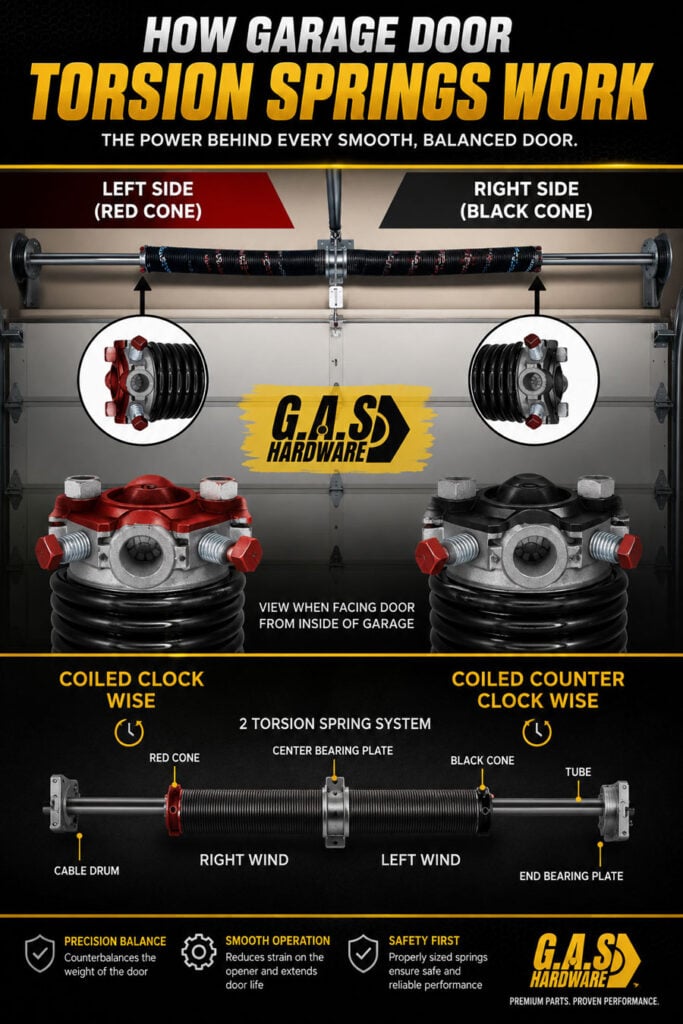
The system typically includes:
Torsion Springs
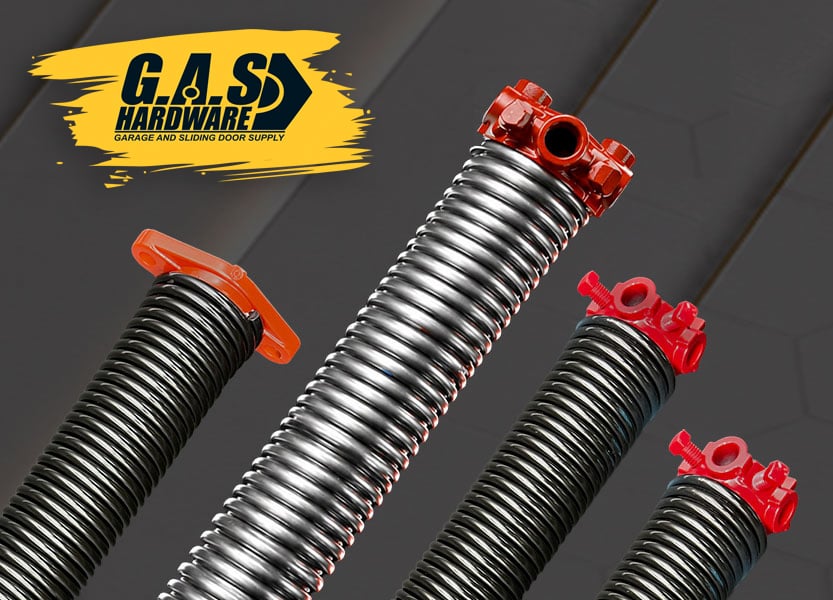
Heavy-duty steel coils that store energy when wound. A garage door may use one spring or multiple springs depending on the weight and design of the door.
Torsion Tube or Shaft
The steel tube running through the springs. As the springs apply torque, the tube transfers that force to the cable drums.
Winding Cones
Located at the ends of the springs, winding cones allow a technician to apply the correct amount of tension to the spring.
Stationary Cones
The stationary ends of the springs are secured at the center bearing plate or spring anchor bracket.
Cable Drums
Located near the ends of the torsion tube. The lift cables wrap around these drums as the door opens.
Lift Cables
Heavy-duty cables connect the bottom of the garage door to the cable drums and transfer the lifting force to the door.
Bearing Plates
Bearings support the torsion tube and allow it to rotate smoothly as the garage door operates.
What Happens When the Garage Door Closes?
As the garage door travels downward, the lift cables unwind from the cable drums.
The torsion tube rotates, causing the torsion springs to wind tighter.
This winding action stores mechanical energy in the springs.
By the time the door reaches the floor, the springs contain the greatest amount of stored energy.
This is one reason torsion springs require careful handling. Even with the garage door completely closed, a properly wound spring remains under significant tension.
Why Does a Garage Door Need the Correct Torsion Springs?
A torsion spring isn’t simply a generic replacement part.
The spring must be properly matched to the garage door.
Several specifications determine how a torsion spring performs, including:
- Wire diameter
- Inside diameter
- Spring length
- Wind direction
- Door weight
- Spring cycle rating
A spring that is incorrectly sized can cause the door to be improperly balanced.
Too much spring force can cause the door to rise too aggressively. Too little spring force can leave the door extremely heavy and place unnecessary strain on the garage door opener and other components.
Replacing a torsion spring?
Before ordering a replacement, you’ll need to correctly identify the specifications of your existing spring.
Why Do Some Garage Doors Have Two Torsion Springs?
Depending on the size and weight of the garage door, a torsion system may use one spring or two.
On many two-spring systems, the springs are wound in opposite directions. One is a right-wound spring and the other is a left-wound spring.
Together, the springs provide the torque necessary to properly counterbalance the door.
The wind direction is important when ordering replacement springs. Installing the wrong wind direction will prevent the torsion system from operating correctly.

What Happens When a Torsion Spring Breaks?
When a torsion spring breaks, it can no longer provide the force needed to counterbalance the garage door.
The door may suddenly become extremely heavy.
Common signs of a broken torsion spring include:
- A visible gap in the spring coils
- The garage door won’t open
- The opener attempts to lift the door but struggles
- The door lifts only a few inches before stopping
- The door feels unusually heavy when operated manually
- A loud bang was heard from the garage
That loud bang is often the sound of the spring releasing its stored energy when it breaks.
Can a Garage Door Opener Lift a Door With a Broken Spring?
A garage door opener may sometimes move a door with a damaged or broken spring, but it should not be relied upon to lift the full weight of the garage door.
Attempting to repeatedly operate a door with a broken spring can put excessive strain on the opener and other components.
If the door suddenly becomes unusually heavy or the opener struggles to lift it, stop operating the system and inspect the springs.
How Long Do Garage Door Torsion Springs Last?
Torsion spring life is generally measured in cycles, rather than years.
One complete opening and closing of the garage door equals one cycle.
The expected lifespan depends on the spring design, how frequently the garage door is used, the operating environment, and the quality of the spring.
The industry standard for oil-tempered torsion springs bought from large retailers is around 10,000 cycles. Some manufacturers offer higher quality springs for enhanced performance. The electrophoretically-coated springs (oiling not needed) sold by G.A.S Hardware have an estimated up to 20-30,000 cycle lifespan, while G.A.S galvanized springs are rated for up to 70,000 cycles
Higher-cycle springs are designed to withstand significantly more opening and closing cycles than standard replacement springs, making them particularly valuable for frequently used residential doors and commercial applications.
Are Garage Door Torsion Springs Dangerous?
Yes. A torsion spring can store a significant amount of mechanical energy.
Improper adjustment, removal, or installation can cause the spring or related hardware to move suddenly and with considerable force.
Anyone working on a torsion spring system should understand the risks, use appropriate tools and safety procedures, and never loosen spring hardware without understanding how the system is tensioned.
Homeowners who are uncomfortable working with high-tension garage door components should contact a qualified garage door professional.
How Do I Know Which Replacement Torsion Spring I Need?
You should not choose a replacement torsion spring based only on how the spring looks.
Correct identification requires several measurements from the existing spring, including:
1. Wire diameter
2. Inside diameter
3. Overall spring length
4. Wind direction
Accurate measurements are important because small differences in spring specifications can significantly change how the spring performs.
We’ve created a complete step-by-step guide showing exactly how to obtain these measurements.
Shop Garage Door Torsion Springs
G.A.S. Hardware supplies professional-grade torsion springs and garage door hardware for residential and commercial applications.
Whether you’re replacing a single residential spring or purchasing springs in volume for a garage door business, choosing the correct spring specifications is essential for proper door balance and reliable operation.
Frequently Asked Questions About Torsion Springs
Do torsion springs lift the garage door?
Torsion springs counterbalance the weight of the garage door. As the springs unwind, they rotate the torsion shaft and cable drums, which wind the lift cables and help raise the door.
Does the garage door opener lift the weight of the door?
Not by itself. On a properly balanced system, the springs offset most of the door’s weight. The opener controls the movement of the balanced door.
Why are torsion springs mounted above the garage door?
Mounting the torsion system above the door allows the springs to apply torque to a shaft connected to cable drums on both sides of the door.
Why are there two springs on some garage doors?
Two springs may be used to provide the required lifting force for the weight and configuration of the door. Two-spring systems commonly use springs wound in opposite directions.
Can I replace a garage door spring with one that looks similar?
No. Replacement springs should be matched using the proper spring specifications rather than appearance alone.
Need Garage Door Springs or Replacement Hardware?
G.A.S. Hardware supplies garage door professionals and customers nationwide with torsion springs, extension springs and the hardware needed to keep garage doors operating properly.
SHOP ELECTROPHORETICALLY-COATED TORSION SPRINGS